
Home Multi-Country Search About Admin Login

Search by
Select Region(s) to search
Hold Ctrl (Windows/Linux) or Command (Mac) to select multiple
Messak Formation
Click to display on map of the Ancient World at:
Messak Fm base reconstruction

Messak Fm


Period: 
Cretaceous

Age Interval: 
Kimmeridgian through Barremian


Province: 
Murzuq Basin

Type Locality and Naming

“Type section at Jabal Msak escarpment south of Awbari, western Murzuq Basin, Libya. Klitzsch (1969) named it after Jabal Msak (24°20′N, 26°00′E).” (LeBlanc, 2022; see NigerLex.geolex.org). Google Gemini: “The Messak Fm is a major Late Jurassic to Early Cretaceous continental sandstone unit composed mainly of braided-stream and fluvial deposits, it reaches hundreds of meters in thickness and features fossilized river systems, charophytes, and dinosaur trackways.”

Synonym: Msak Fm (e.g., J. LeBlanc, 2022, see NigerLex.geolex.org). “The Msak Fm also bare the informal and ambiguous name of “Nubian Formation” or “Nubian Sandstone Formation” (Grès de Nubie) further north in the Murzuq Basin (Hallett, 2002, p. 169).” (LeBlanc, 2022).

References: Klitzsch, 1971; Aziz, 2000; Hallett, 2002; Marzo and Ramos, 2003


Lithology and Thickness
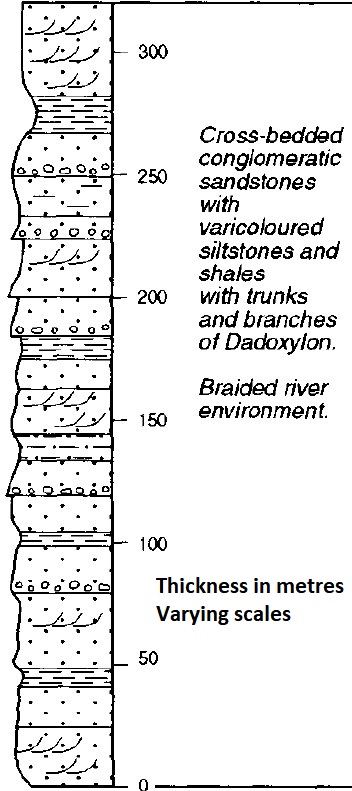
It comprises 330m of continental sandstones and shales, frequently conglomeratic, often cross-bedded, and occasionally ferruginous (Hallett, 2002). The formation is usually divided into a lower Jarmah Member and an upper Awbari Member, both consisting of continental clastics deposited in a predominantly braided stream environment, but with interbedded lake and swamp deposits (Aziz, 2000). [See https://nigerlex.geolex.org/uploads/Msak%20Fm/lithology/Msak%20Fm%20strat%20column%20Fig_2.jpg] for typical stratigraphic column.]


Lithology Pattern: 
Clayey sandstone


Relationships and Distribution

Lower contact

It unconformably overlies the Taouratine Fm; or unconformably overlies the Tilemsin Fm, depending upon the local stratigraphic nomenclature.

Upper contact

It is unconformably overlain by uppermost Cretaceous marine deposits of the Zman Fm in Libya The unconformity is sometimes termed the Alpine unconformity – Marzo and Ramos, 2003. In Niger, the Djado Basin portion of the greater Murzuq Basin, it is either overlain by the Totomaye Fm sandstone of upper Maastrichtian-Paleocene or by Quaternary deposits.

Regional extent

Murzuq Basin, Fezzan region, SW Libya. Google Gemini: “The Messak Fm is a major Late Jurassic to Early Cretaceous continental sandstone unit in southwestern Libya, primarily exposed in the Murzuq Basin and the Messak Settafet plateau. Forms a dramatic, erosion-resistant dark sandstone escarpment (Messak Settafet and Messak Mellet) rising sharply above surrounding sand seas.


GeoJSON

{"type":"Feature","geometry":{"type":"Polygon","coordinates":[[[10.976,25.209],[12.169,25.606],[13.321,26.008],[14.39,26.376],[15.419,26.748],[16.2,27.199],[16.735,26.044],[17.105,24.852],[16.982,23.663],[16.53,22.58],[15.871,21.533],[16.036,20.708],[17.023,20.089],[18.175,19.575],[19.45,19.247],[18.628,18.748],[16.776,18.604],[14.761,18.661],[12.992,18.923],[11.84,19.515],[11.223,20.335],[10.812,21.372],[10.524,22.613],[10.359,23.904],[10.976,25.209]]]}}

Fossils

Google Gemini: “Plant microfossils (charophytes), and ostracods Notable for significant fossil discoveries, including extensive tracks and trackways left by theropod dinosaurs walking on humid mud/sand layers.


Age 

Shown in Fello (2001)’s Repsol regional column as uppermost Early Cretaceous; however, Google Gemini summarizes from later literature as Kimmeridgian through Barremian: “Kimmeridgian: Marks the initial depositional phase of the formation. … Valanginian: Continuous continental sand deposition. Hauterivian: Dominated by high-energy braided-river systems. Barremian: Marks the upper age limit of the formation's topmost strata.” [However, span is given as Berriasian through Hauterivian – a shorter interval – by J. LeBlanc, 2022], based on “Tekbali (1994) concluded a Late Berriasian (Early Cretaceous) age for the lower part of the Jarmah Member in southwestern Libya based on palynological (pollen-spore) findings of Cicatricosisporites 5A, Pilosisporites trichopapillosus, Aequitriradites spinulosus, and Trilobosporites apiverrucatus.).

Age Span: 

    Beginning stage: 
Kimmeridgian

    Fraction up in beginning stage: 
0.00

    Beginning date (Ma): 
154.78

    Ending stage: 
Barremian

    Fraction up in the ending stage: 
0.5

    Ending date (Ma):  
123.95

Depositional setting

Braided stream environment, with interbedded lake and swamp deposits (Aziz, 2000). Google Gemini summary: “Characterized by high-energy, stacked cross-bedded braided sandstones and meandering channel deposits laid down by ancient river networks. … Deposited during a much more humid phase in Saharan history, evidenced by localized clay/silt lake lenses, plant microfossils (charophytes), and ostracods.”


Depositional pattern:  


Additional Information

The dark, varnish-coated rocks of the formation preserve rich prehistoric rock art and stone tool quarries, though the region's surface geology is also heavily impacted by modern petroleum exploration operations.


Compiler:  

Enam O. Obiosio, Solomon Joshua Avong and Henry Nasir Suleiman (2026). The Cretaceous and Cenozoic entries were mainly taken from AI-assistant summaries of Google’s Gemini (accessed in Aug’2026)